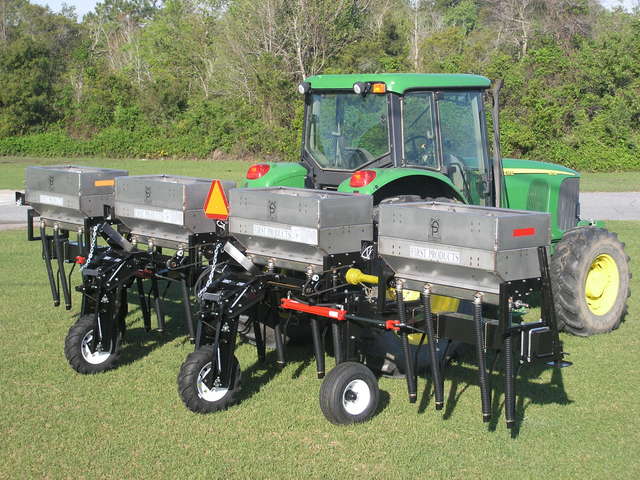
Fertilizer is one of the most important inputs in agriculture, directly influencing crop yields, soil performance, and long-term field sustainability. Yet, with rising costs of inputs and greater emphasis on conservation practices, the way fertilizer is applied is just as important as the type being used. The choice of a fertilizer applicator impacts not only efficiency in the field but also how well nutrients reach the root zone when crops need them most.
Two of the most widely used tools in modern agriculture are dry fertilizer applicators (often called dry fertilizer spreaders) and liquid fertilizer applicators. Each has unique strengths. Dry systems are ideal for broad coverage and long-term nutrient release, while liquid systems excel at precision and fast nutrient uptake. The challenge for operators is deciding which method best matches their soil conditions, cropping system, and timing needs.
Whether managing row crops, renovating pastures, or improving wildlife food plots, fertilizer application must align with agronomic goals. With solutions ranging from dry fertilizer applicators to liquid fertilizer systems, and modular equipment that integrates with drills and planters, 1st Products offers tools designed for efficiency, precision, and long-term ROI.
Understanding the role of each applicator type allows operators to create tailored nutrient programs that maximize performance across all types of fields.
Understanding Fertilizer Applicators in Modern Agriculture
A fertilizer applicator is more than just a delivery tool. It is a precision instrument that ensures nutrients are placed exactly where they are needed, at the right rate, and at the right time. In modern farming, this level of precision matters more than ever, as producers seek to balance yield goals with sustainability and cost control.
Applicators are generally designed around two systems: dry fertilizer applicators and liquid fertilizer applicators. Dry units spread granular material across the soil surface, often at planting or pre-planting stages, while liquid units inject or spray nutrients in solution form for fast crop uptake. Both systems can now be integrated with planters, drills, and modular field equipment, allowing operators to reduce passes and combine tasks such as seeding and fertilization.
Another key advancement is compatibility with GPS and variable-rate technology. Instead of applying nutrients uniformly across an entire field, operators can now tailor application rates based on soil maps and fertility zones. This not only saves inputs but also reduces environmental runoff and ensures crops get the nutrients they need in the areas they need them most.
At 1st Products, applicators are designed with versatility and field efficiency in mind. Whether paired with a drill for one-pass seeding and fertilizing, or used as standalone equipment for seasonal nutrient applications, the focus is on helping operators improve ROI while protecting the long-term health of their soil.
For a deeper look at how applicator choice fits into larger cropping systems, see 1st Products’ comparison of no-till vs. conventional drills, which explores how soil preparation and nutrient delivery interact to shape field outcomes.
Dry Fertilizer Applicators: Wide Coverage and Long-Lasting Nutrients
A dry fertilizer applicator—sometimes called a dry fertilizer spreader—is one of the most widely used tools in farming because of its ability to cover large areas efficiently. These systems deliver granular nutrients such as nitrogen, phosphorus, and potassium directly to the soil surface, providing crops with a steady source of nutrition throughout the growing season.
Why Dry Fertilizer Applicators Stand Out
- Long-Term Nutrient Release
Dry fertilizers are often formulated for slow and consistent release. This ensures nutrients are available to plants across multiple growth stages, which is particularly valuable in row crops, pastures, and hay fields where long-term fertility is required. - Efficiency on Large Acreage
With the ability to spread material evenly over broad areas, a dry fertilizer applicator minimizes the number of field passes required. This reduces fuel use, labor hours, and overall compaction. - Ease of Handling and Storage
Granular fertilizers are generally easier to store and transport compared to liquids. They can be purchased in bulk and stored until needed, making them a cost-effective choice for many operations. - Versatility Across Crop Types
From row crops to perennial forage systems, dry fertilizer spreaders deliver nutrients in ways that support both immediate and seasonal crop demands.
The 1st Products Dry Fertilizer Applicator is engineered for precision and durability, ensuring even distribution across variable terrain. Its modular design allows it to be paired with other equipment for efficient one-pass operations, giving operators flexibility in how and when they apply nutrients.
For practical details on setup, calibration, and performance in the field, see 1st Products’ Dry Fertilizer FAQ, which answers common questions and highlights best-use practices for maximizing results.
Liquid Fertilizer Applicators: Precision and Fast Uptake
A liquid fertilizer applicator delivers nutrients in solution form, offering one of the fastest ways to make essential elements available to crops. These systems are especially valuable during critical growth stages when plants need immediate access to nitrogen or micronutrients. By delivering fertilizer either directly to the soil or as a foliar spray, liquid systems provide flexibility and accuracy that can make a significant difference in crop performance.
Why Liquid Fertilizer Applicators Excel
- Rapid Nutrient Availability
Liquids are absorbed quickly, making them ideal for early growth phases, stressed crops, or environments where nutrients must be supplied on short notice. Farmers often use liquid applications to provide a targeted boost during periods of high nutrient demand. - Precision Application
A liquid fertilizer applicator allows nutrients to be applied exactly where they are needed—whether banded beside the row, injected into the soil, or sprayed as a foliar treatment. This precision reduces waste and improves return on investment, particularly in high-value crops. - Flexibility in Timing
Liquids can be applied pre-plant, at planting, or in-season, depending on crop requirements. They are especially effective as top-dress or sidedress treatments, giving farmers more options to adjust fertility throughout the growing cycle. - Compatibility with Integrated Systems
Liquid applicators can be paired with planters, drills, or sprayers to maximize efficiency. This integration allows operators to fertilize and seed in one pass, saving time and reducing soil compaction.
The 1st Products Liquid Fertilizer Applicator is designed to support these advantages, offering modular integration that aligns with modern seeding and tillage systems. Its versatility makes it an ideal solution for operators managing both row crops and specialty applications like pastures or food plots.
To better understand practical applications, see 1st Products’ Liquid Fertilizer FAQ, which explains common setup options, maintenance needs, and field benefits.
Comparing Dry vs. Liquid Fertilizer Applicators
When choosing between a dry fertilizer applicator and a liquid fertilizer applicator, the decision often comes down to nutrient release, application timing, and field goals. Both systems play an important role in modern nutrient management, and in many operations, they are used side by side for complementary benefits.
When to Use a Dry Fertilizer Applicator
Dry fertilizer spreaders excel at building long-term soil fertility. Nutrients such as phosphorus and potassium are often applied in granular form at or before planting, helping crops establish a strong foundation for growth. Dry fertilizers are also easier to purchase and store in bulk, making them well-suited for operators covering large acreages.
When to Use a Liquid Fertilizer Applicator
Liquid fertilizer applicators shine when flexibility and precision are top priorities. Because nutrients are immediately plant-available, liquids are especially effective for sidedress or in-season applications. They allow operators to correct deficiencies quickly or give crops a boost during periods of high nutrient demand. Liquids also integrate well with planters and drills for efficient one-pass planting and fertilizing.
Balancing the Two Approaches
In practice, many farms combine dry and liquid applications to build a complete fertility program. Dry fertilizer is often applied pre-plant to establish a nutrient base, while liquid fertilizer is used during the growing season for timely supplementation. This strategy ensures steady nutrient availability throughout the crop cycle.
A helpful example of this balance can be found in 1st Products’ discussion of spot-treatment vs. even-spread fertilizer applications, which explains how to align application type with agronomic goals.
Ultimately, the “best” fertilizer applicator isn’t one or the other—it’s the one that fits your operational needs, crop system, and timing windows.
Equipment Versatility and Multi-Pass Efficiency
Fertilizer application is rarely a standalone task in today’s operations. With rising input costs and tighter planting windows, efficiency is often measured by how many processes can be combined into a single pass. This is where equipment versatility becomes just as important as the choice between dry or liquid fertilizer.
Integrated Systems for Efficiency
Modern applicators can be paired with drills, planters, or tillage tools to perform multiple operations simultaneously. For example, pairing a fertilizer applicator with a seeding drill allows operators to place seed and nutrients in one pass, ensuring the fertilizer is positioned where roots will access it most effectively. This approach reduces fuel use, operator hours, and soil compaction—all while improving stand establishment.
The Role of Modular Equipment
Tools like the MULTI-drill highlight how modular design supports this efficiency. By integrating interchangeable boxes and fertilizer attachments, operators can quickly adapt equipment to handle different seed types, fertilizer forms, or field conditions. This adaptability is especially valuable for farms managing diverse systems such as pasture renovation, cover cropping, and wildlife food plots.
Accessories That Expand Functionality
Beyond basic integration, specialized agriculture accessories expand what applicators can accomplish. From precision seed meters to fertilizer hoppers, these add-ons help operators fine-tune placement, increase coverage consistency, and improve overall return on investment.
For a broader perspective on how combining operations drives measurable improvements, see 1st Products’ insights on modern equipment efficiency and ROI. Multi-function tools are not only reducing labor requirements but also helping farms achieve stronger agronomic results with fewer inputs.
Making the Right Choice for Your Farm
Deciding between a dry fertilizer applicator and a liquid fertilizer applicator is less about which is “better” and more about which aligns with your soil conditions, crop rotations, and operational priorities. Each system has its place, and many successful farms use both strategically throughout the season to create a balanced fertility program.
Key Considerations for Fertilizer Applicator Selection
- Crop Requirements
- Field crops like corn, soybeans, and small grains often rely on dry fertilizers to establish a nutrient foundation.
- Specialty crops, pastures, and food plots may benefit from liquid fertilizers that deliver fast uptake during key growth stages.
- Field crops like corn, soybeans, and small grains often rely on dry fertilizers to establish a nutrient foundation.
- Soil Type and Field Conditions
- Heavy soils with slower drainage may respond better to dry fertilizers that release nutrients gradually.
- Sandy or light soils often benefit from liquid fertilizers that deliver nutrients directly when plants need them most, minimizing leaching losses.
- Heavy soils with slower drainage may respond better to dry fertilizers that release nutrients gradually.
- Application Timing
- Dry fertilizer spreaders are typically used before planting or at planting to build long-term fertility.
- Liquid fertilizer applicators are ideal for in-season adjustments or supplemental feeding when crops show nutrient stress.
- Dry fertilizer spreaders are typically used before planting or at planting to build long-term fertility.
- Operational Efficiency
- Farms with limited labor or tight planting windows may prioritize modular systems that combine planting and fertilizing in a single pass.
- Having both dry and liquid options on hand can provide flexibility when weather or timing shifts unexpectedly.
- Farms with limited labor or tight planting windows may prioritize modular systems that combine planting and fertilizing in a single pass.
At the end of the day, the right fertilizer applicator is the one that helps you meet your agronomic and operational goals without adding unnecessary complexity. With modular and American-made equipment from 1st Products, operators gain access to adaptable tools designed for durability, precision, and long-term field performance.
For further perspective on equipment choices and efficiency trade-offs, 1st Products’ overview of liquid vs. dry fertilizer applicators outlines practical scenarios that can help guide decision-making.
Fertilizer Applicators that Support Long-Term Success
Fertilizer application is never one-size-fits-all. Dry applicators deliver broad coverage and long-term nutrient release, while liquid applicators provide flexibility and fast uptake. By choosing the right fertilizer applicator for each field condition and crop stage, operators can strengthen stands, conserve resources, and increase efficiency.
With adaptable solutions like dry fertilizer applicators and liquid fertilizer applicators, 1st Products helps farmers and land managers integrate effective nutrient management into everyday field operations—building healthier soils and stronger crops season after season.
{ "@context": "https://schema.org", "@type": "FAQPage", "mainEntity": [ { "@type": "Question", "name": "What is the main difference between liquid and dry fertilizer applicators?", "acceptedAnswer": { "@type": "Answer", "text": "Dry fertilizer applicators spread granular nutrients over the soil surface for gradual, long-term nutrient release. Liquid fertilizer applicators deliver nutrients in solution form for fast uptake, often applied through injection or foliar spray. Dry systems suit pre-plant applications and large acreage, while liquid systems excel at precision, in-season treatments, and quick nutrient delivery." } }, { "@type": "Question", "name": "When should you use a dry fertilizer applicator?", "acceptedAnswer": { "@type": "Answer", "text": "Use a dry fertilizer applicator before or during planting to establish long-term soil fertility. Dry systems are ideal for spreading nutrients like phosphorus and potassium across large acreages. Their slow-release characteristics support consistent nutrition through multiple crop stages, making them a good fit for row crops, pastures, and hay fields." } }, { "@type": "Question", "name": "When is a liquid fertilizer applicator the better choice?", "acceptedAnswer": { "@type": "Answer", "text": "Liquid fertilizer applicators are best when precise, fast nutrient uptake is needed. They are ideal for sidedressing, topdressing, or foliar applications during critical growth periods. Liquids can be easily paired with drills or planters for one-pass planting and fertilizing, helping reduce labor and fuel use while ensuring nutrients reach the root zone quickly." } }, { "@type": "Question", "name": "Can dry and liquid fertilizer systems be used together?", "acceptedAnswer": { "@type": "Answer", "text": "Yes. Many operations combine dry and liquid applications for complementary benefits. Dry fertilizer provides a long-term nutrient foundation pre-plant, while liquid fertilizer supplements crops during key growth stages for rapid response. This balanced approach ensures steady nutrition and supports better yield potential throughout the season." } }, { "@type": "Question", "name": "How can modular equipment improve fertilizer application efficiency?", "acceptedAnswer": { "@type": "Answer", "text": "Modular fertilizer applicators allow multiple functions—like seeding, fertilizing, and tilling—to be completed in a single pass. Equipment such as the MULTI-drill from 1st Products integrates interchangeable boxes and attachments for both dry and liquid applications. This versatility reduces field passes, fuel use, and labor while improving overall precision and ROI." } } ] }