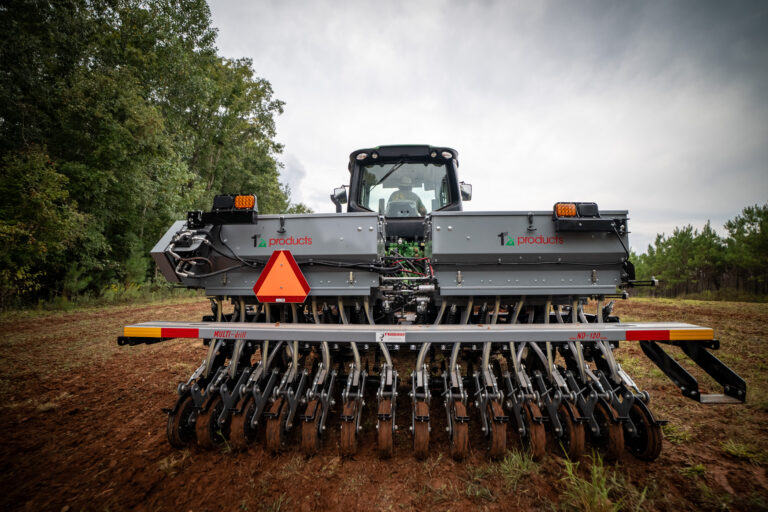
There’s no shortage of ways to get seed into the ground. Broadcast spreading, hydroseeding, hand seeding, slit seeding — each method has its advocates and its appropriate uses. But there are specific conditions and scenarios where seed drills don’t just perform well, they outperform everything else on the field.
Understanding when that’s the case helps you make better equipment decisions, waste less seed, and get stands that actually deliver on the effort you put in.
What Makes Seed Drills Different
Before getting into the scenarios, it helps to understand why seed drills perform the way they do. A seed drill opens a narrow furrow in the soil, deposits seed at a precise depth and rate, then closes the furrow back around it. Every step is mechanical and controlled.
According to research from the USDA Agricultural Research Service, drill seeding consistently produces higher, more uniform stands compared to broadcast methods, particularly in dry conditions where seed-to-soil moisture contact is critical. That outcome comes down to three things a drill controls that broadcast methods don’t: seed depth, seed rate, and seed protection.
Scenario 1: Dry or Variable Soil Conditions
Broadcast seeding depends heavily on rain doing the work of pushing seed into contact with the soil. In wet years with good timing, that’s manageable. In dry springs, hot early summers, or regions with unpredictable rainfall, broadcast seed sitting on the surface dries out before it ever germinates.
A seed drill eliminates that dependency. Because seed is placed below the surface at the depth where soil moisture is more consistent, it has access to the moisture it needs from the moment it’s planted. This is one of the clearest advantages of seed drills, and it’s the reason experienced operators in drier climates and drought-prone regions consistently prefer them over broadcast alternatives.
For hunters and land managers dealing with variable spring weather, this reliability is a significant reason the 1st Products MULTI-drill has become a go-to for food plot establishment across the Southeast and beyond.
Scenario 2: No-Till Situations
No-till farming and food plot management have grown significantly as land managers recognize the long-term soil health benefits of reducing disturbance. The challenge is that no-till environments, with their existing residue, vegetation, and compacted surface layers, make broadcast seeding even less effective than usual. Seed dropped onto a heavy residue layer often never reaches the soil at all.
A no-till seed drill is specifically engineered for this. Heavy disc openers cut through surface residue and into the soil below, placing seed precisely where it needs to be without requiring any prior tillage pass. You preserve the soil structure, skip the extra equipment run, and still get reliable seed placement.
The MULTI-drill’s no-till design handles conditions from open pasture to heavily wooded food plot terrain, making it one of the more versatile options for operators who aren’t working uniform, tilled ground. You can read more about how no-till technology fits into a larger equipment strategy in our post on how modern agricultural equipment drives efficiency and ROI.
Scenario 3: High-Value Seed
When you’re planting commodity seed at low cost per pound, some broadcast loss is just part of the math. When you’re planting expensive specialty grass varieties, premium wildlife mixes, or high-purity forage blends, that calculation changes entirely.
Seed drills are the most seed-efficient planting method available. Because every seed is placed at a controlled depth with good soil contact, germination rates go up and waste goes down. You plant less to get more, which matters most when the seed itself represents a significant part of your investment.
According to Wikipedia’s overview of seed drill history, the shift from broadcast sowing to mechanical drilling improved the ratio of crop yield to seed planted by as much as eight times over early broadcast methods. The principle hasn’t changed, only the precision of the equipment delivering it.
Scenario 4: Large Acreage Requiring Consistency
Broadcast seeding on a small patch of lawn is one thing. Broadcast seeding across ten, twenty, or fifty acres is another. At scale, the variability in broadcast coverage becomes more pronounced. Wind drift, operator speed, terrain changes, and spreader calibration drift all add up to uneven stands across large areas.
A seed drill mechanically meters seed at a fixed rate per acre regardless of terrain, operator pace, or wind. Whether you’re on the first pass or the fortieth, the seed rate and depth stay consistent. That consistency is what separates a uniform stand from a patchy one on large acreage, and it’s why farmers, golf course operators, and large-scale food plot managers all tend to use drill-based seeding for their most important work.
The agriculture equipment lineup at 1st Products includes MULTI-drill models from 5ft to 12ft working widths, scaled to match the acreage you’re actually working without over- or under-equipping for the job.
Scenario 5: Diverse Seed Mixes
Planting a blend of multiple species, like a typical food plot mix combining brassicas, clovers, and cereal grains, creates a challenge for broadcast methods. Different seed sizes, weights, and shapes distribute differently from a broadcast spreader, meaning your mix arrives in the field unevenly separated before it ever hits the ground.
A seed drill meters and delivers the blend uniformly across every row, so the stand that comes up reflects the mix you put in rather than whatever happened to fly the farthest or fall the fastest. For food plotters running diverse mixes and pasture managers rotating between species, this consistency makes a real difference in how the finished stand performs.
When Seed Drills Aren’t the Right Call
In fairness, seed drills aren’t always the right tool. On very steep or inaccessible slopes, maneuverability can be a limiting factor. For very light overseeding on established, healthy turf where minimal intervention is the goal, a broadcast spreader may be all that’s needed. And for certain fluffy native seed varieties that don’t flow well through standard metering systems, specialized equipment or adjusted methods may be necessary.
The key is matching the tool to the situation. When the conditions above are in play, seed drills aren’t just a better option, they’re often the only option that reliably delivers the stand you’re after.
The Bottom Line
Seed drills outperform other seeding methods when soil conditions are variable, when you’re working no-till ground, when seed cost makes waste unacceptable, when acreage demands consistency, and when you’re planting diverse mixes that need even distribution. In any of those situations, the precision of a drill pays for itself in the quality of the stand you get.
Looking for the right seed drill for your operation? Explore the full MULTI-drill lineup or to see the equipment in person.