Compacted soil on the game field.
Thin turf that needs seed before the window closes.
A renovation project that calls for pulled cores, not punched holes.
Three different jobs, and the old assumption says three different machines.
That assumption is what this post is here to challenge. If you’re shopping for a commercial aerator, the most important thing to know about 1st Products equipment isn’t any single machine. It’s that the machine you buy for today’s problem is already built to solve the next four, because every one of them runs on the same foundation: the Universal Frame System.
What Is the Universal Frame System?
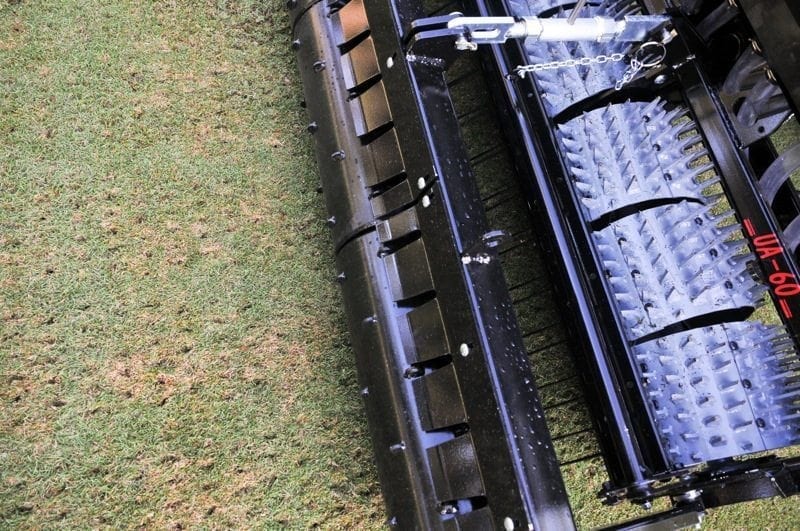
The Universal Frame System is the PTO-driven frame at the core of every 1st Products ground-engaging turf machine. It carries the gearbox, the drive, and the hitch, and it accepts interchangeable shafts, the working components that actually engage the turf.
Here’s the part that surprises people: the AERA-vator Shaft creates the signature aeration action of the AERA-vator, the machine golf courses and sports fields have trusted for decades. Its vibrating tine rotor is one of five interchangeable shafts that run on the same Universal Frame System.
That means the machine you buy for one job is already the platform for four others. The frame comes in three working widths, 40, 60, and 80 inches, so it scales from compact tractors to full-size units covering large properties.
The Five Shafts and the Jobs They Solve
Each shaft is a standalone tool built for a specific turf problem. Every one of them mounts on the Universal Frame System.
AERA-vator Shaft. The flagship. Vibrating tines fracture compacted soil at roughly 55 holes per square foot without pulling cores, so there’s no plug cleanup and minimal surface disruption. This is the aeration approach that keeps surfaces in play, which is why it’s been the go-to on golf courses and athletic fields for decades.
Multi-Tine Shaft. Fewer, heavier tines for deeper, more aggressive compaction relief. Forged and hardened tines penetrate with a deeper vibration action than the standard AERA-vator Shaft, built for ground that’s beyond what standard aeration can fix.
Slicer Shaft. Hardened spring steel blades slice clean slits through the turf, opening the surface for air, water, and seed without tearing it up. A fit for regular in-season maintenance when the turf can’t afford visible disruption.
Coring Shaft. Traditional core aeration on the same platform. Hardened steel spoons pull plugs at depths up to 4 1/2 inches, for the renovation windows when you want material removed from the profile, not just fractured.
Power Seeder Shaft. Aeration and seeding in a single pass. The shaft opens the soil while the seed box meters seed directly into the freshly opened seedbed, giving seed the best possible soil contact at the moment the ground is most receptive.
Why the Platform Approach Matters
Buying single-purpose turf machines means every new job is a new machine: new capital, new maintenance, new trailer and shop space. For most operations, that’s the single biggest constraint on doing renovation work correctly, because the right tool for the job is the one you couldn’t justify buying.
The Universal Frame System changes that math. Every shaft comes mounted on a Universal Frame System by default, so your first purchase is a complete, ready-to-run machine. But once you own that frame, adding a capability means adding a shaft, not buying another whole machine.
In practice, that looks like this: an operation buys a AERA-vator for routine compaction relief. Two seasons later, a renovation project calls for true core aeration. Instead of pricing a separate core aerator, they add the Coring Shaft to the Universal Frame System they already own. Same tractor setup, same frame, new capability.
Industry groups like the Golf Course Superintendents Association of America (GCSAA) and the Sports Turf Managers Association treat aeration, surface management, and overseeding as foundational recurring practices. The operations that keep up with all of them are usually the ones whose equipment doesn’t force a trade-off between doing the job right and owning another machine.
How to Think About Building Your Lineup
If you’re evaluating a commercial aerator, or any of the five shafts, think in terms of the platform, not just the purchase in front of you.
What job do you need solved right now?
Start there. Compaction points to the AERA-vator or Multi-Tine shaft. Thin turf points to the Power Seeder. Renovation windows point to the Coring Shaft.
What jobs are on your calendar in the next few seasons?
If overseeding, coring, or slicing is in your future, the machine you buy today already carries those capabilities. That should factor into the value of the first purchase.
What width fits your equipment and your properties?
The 40, 60, and 80 inch frame sizes match different tractor setups and acreage. Buy the frame size that fits your operation, and every shaft you add later fits it too.
How much is your current equipment lineup costing you in overlap?
Count the single-purpose machines in your shop that each do one job a few weeks a year. That’s the cost the platform approach eliminates.
One Frame, Five Tools, One Decision
The Universal Frame System is the reason a 1st Products machine is a different kind of purchase than a single-purpose commercial aerator. You buy it for the job in front of you, and it quietly becomes the foundation for the next four.
Start with the problem you need solved. The platform takes care of the rest.
Request a quote to talk through which shaft and frame size fit your operation, and how to build out capabilities from the Universal Frame System you start with.