If you manage turf at a professional level, you’ve likely used both a verticutter and a commercial aerator at some point. They’re both critical renovation tools, they’re both hard on turf in the short term, and they both pay off significantly when used correctly. But they do very different things, and using one when you should be using the other is one of the more common mistakes turf managers make when trying to diagnose and correct a struggling surface.
This guide breaks down what each tool actually does, when to reach for one over the other, and how to think about sequencing them together when your turf needs a more complete renovation.
What a Verticutter Does
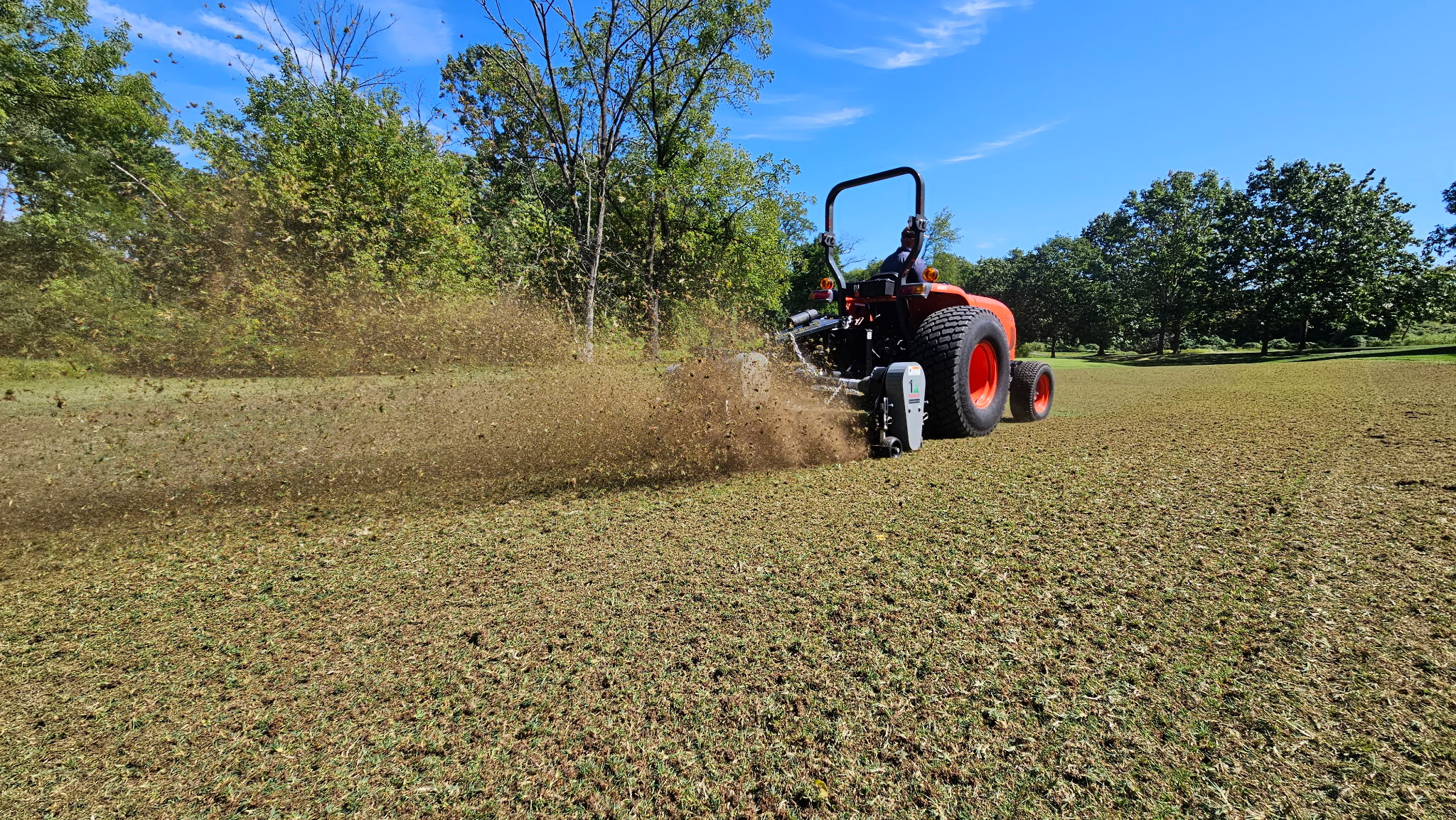
A verticutter, sometimes called a vertical mower or dethatcher, uses vertically oriented blades that spin and cut down into the turf profile. The primary job of a verticutter is to slice through the thatch layer, the dense mat of dead and living organic matter that builds up between the soil surface and the green grass above it.
A thin thatch layer, generally under half an inch, is actually beneficial. It adds cushion, helps regulate soil temperature, and retains moisture. But when thatch accumulates beyond that threshold, it starts working against you. Water can’t penetrate efficiently. Fertilizer gets trapped before it reaches the root zone. Disease pressure increases. And new seed struggles to make contact with the soil during overseeding.
A verticutter cuts through that layer and pulls it to the surface where it can be removed. It also stimulates lateral growth in grass types like bermudagrass, zoysiagrass, and other warm-season varieties, which helps thicken the stand over time. The Sports Turf Managers Association (STMA) identifies thatch management as a foundational practice for athletic field health, particularly on high-traffic surfaces where organic buildup accelerates.
The 1st Products VERTI-cutter line offers two purpose-built options for professional turf applications. The VC-60 features a patented swing-hitch that allows the unit to turn during operation, improving maneuverability on larger fields, while the VC-40 is built for compact tractors with tighter blade spacing options down to half an inch. Both are designed for the duty cycles that professional turf managers actually work at.
What a Commercial Aerator Does
A commercial aerator works below the thatch layer, targeting the soil itself. The goal is to relieve compaction by creating channels in the soil that allow air, water, and nutrients to penetrate more deeply and reach the root zone.
Soil compaction is cumulative. Every pass of a mower, every foot of foot traffic, every rain event on dry soil adds pressure to the soil structure. Over time, the pore spaces that roots depend on get squeezed out, and turf health declines in ways that no amount of fertilizer or irrigation can fix because the inputs simply can’t get where they need to go.
A commercial aerator solves this by physically opening the soil. Depending on the attachment and configuration, it can do this through vibrating tines that fracture compacted zones without removing material, or through more aggressive approaches like coring that pull plugs from the surface.
The Golf Course Superintendents Association of America (GCSAA) recommends aeration as an annual minimum on most golf turf, with high-traffic areas like tees and greens often requiring multiple passes per season. For athletic fields and commercial properties, similar logic applies: the frequency and method depend on traffic load and soil type, but skipping aeration entirely is rarely the right call.
The 1st Products AERA-vator uses a vibrating tine system that fractures compacted soil while preserving the turf surface better than traditional core aerators. Models like the AERA-vator 60T and the AE40E Tow-Behind are built for professional applications ranging from sports complexes to municipal properties, with enough configuration flexibility to match different tractor setups and property sizes.
Key Differences at a Glance
The core distinction is where each tool works in the turf profile. A verticutter works from the surface down through the thatch layer. A commercial aerator works from just below the thatch layer down into the soil.
That means if your problem is thatch, a verticutter is your tool. If your problem is compaction, an aerator is your tool. If you have both, which is common on older or heavily trafficked turf, you likely need both, ideally in the right sequence.
Verticutting also tends to be more aggressive on the visible turf surface in the short term. A freshly verticutted field can look rough for a week or more, which matters on properties that can’t be taken out of play. Aeration with a vibrating tine system like the AERA-vator tends to leave a cleaner surface and faster recovery, which is part of why it’s become the preferred approach on golf courses and athletic fields where appearance and playability can’t slip for long.
When to Use Each One
Use a verticutter when you observe spongy or soft surface feel that indicates thatch buildup, poor water infiltration despite adequate irrigation, increased disease pressure in areas with heavy organic accumulation, or when you’re preparing for overseeding and need better seed-to-soil contact.
Use a commercial aerator when turf feels firm and compacted underfoot, roots are shallow or struggling to develop downward, water puddles or runs off instead of penetrating, or you’re managing a property with consistent heavy traffic like a sports field or golf tee box.
Use both when you’re doing a full renovation, managing a neglected property for the first time, or working to restore a surface that has declined due to a combination of thatch buildup and compaction over multiple seasons.
Sequencing Matters
If you’re using both tools in the same renovation pass, verticutting before aerating is generally the better approach. Removing the thatch layer first allows the aerator’s tines to penetrate more effectively into the soil rather than working through a dense organic mat. After both passes, overseeding and topdressing have a significantly better chance of taking hold because seed can reach the soil and amendments can work their way into the profile.
This kind of integrated renovation approach is what separates turf managers who get consistent results from those who are always chasing problems. The right tools, used in the right order, compound in effectiveness rather than just addressing individual symptoms.
Choosing the Right Equipment for Your Operation
The right choice between a verticutter and a commercial aerator isn’t really about which one is better. It’s about accurately diagnosing what your turf actually needs and then matching your equipment to that diagnosis.
If your operation regularly handles both thatch management and compaction relief across different properties or different parts of the same property, having access to both tools gives you the flexibility to address problems correctly rather than defaulting to whatever you have on hand. Explore the full 1st Products turf equipment lineup to see how the VERTI-cutter and AERA-vator are built for professional turf applications, or contact the team to talk through which configuration makes sense for your specific setup.