Thatch is one of those turf problems that builds slowly and quietly until it becomes impossible to ignore. By the time a turf manager can clearly see the effects of excessive thatch buildup on surface performance, it has usually been accumulating for a full season or more. The turf feels spongy underfoot. Water sits on the surface instead of infiltrating. Fertilizer applications produce diminishing returns. Disease pressure increases in predictable patterns.
All of these symptoms trace back to the same underlying issue: a thatch layer that has grown thick enough to interfere with the basic functions that healthy turf depends on.
A verticutter is the most direct tool for addressing this problem. Used correctly and on the right schedule, it removes accumulated thatch, stimulates the lateral growth that builds turf density, and creates a surface environment where seed, water, and nutrients can actually reach the soil. This guide covers how verticutters work, when to use them, and what distinguishes professional-grade equipment from machines that fall short under real-world conditions.
What Thatch Is and Why It Accumulates
Thatch is the layer of living and dead organic matter that develops between the soil surface and the base of the green grass above it. It includes decomposing grass stems, roots, and other plant material that breaks down more slowly than it accumulates under certain conditions.
A thin thatch layer, generally under half an inch, is actually beneficial. It adds cushion to the turf surface, helps moderate soil temperature, and retains some moisture between irrigation cycles. Many turf management programs deliberately maintain a minimal thatch layer for these reasons.
The problem starts when thatch accumulates faster than it decomposes. This happens most readily on turf that receives heavy nitrogen fertilization, frequent irrigation, and consistent traffic, all of which accelerate grass growth while slowing the microbial decomposition that breaks down organic matter. Certain grass species are also naturally more prone to thatch buildup. Bermudagrass, zoysiagrass, and Kentucky bluegrass produce lateral stems and rhizomes that contribute to thatch more aggressively than other varieties.
When thatch exceeds roughly three-quarters of an inch, the negative effects start to outweigh the benefits. Water infiltration suffers because the dense organic mat resists penetration. Roots begin to develop in the thatch layer itself rather than in the soil below, which makes them more vulnerable to heat, drought, and cold stress. Pest and disease organisms find favorable habitat in the warm, moist thatch environment. And overseeding results deteriorate because seed can’t reach the soil through the accumulated layer.
The Golf Course Superintendents Association of America (GCSAA) identifies thatch management as one of the core practices in professional turf programs, noting that thatch depth should be monitored regularly and addressed before it reaches the threshold where it begins visibly affecting surface performance.
How a Verticutter Works
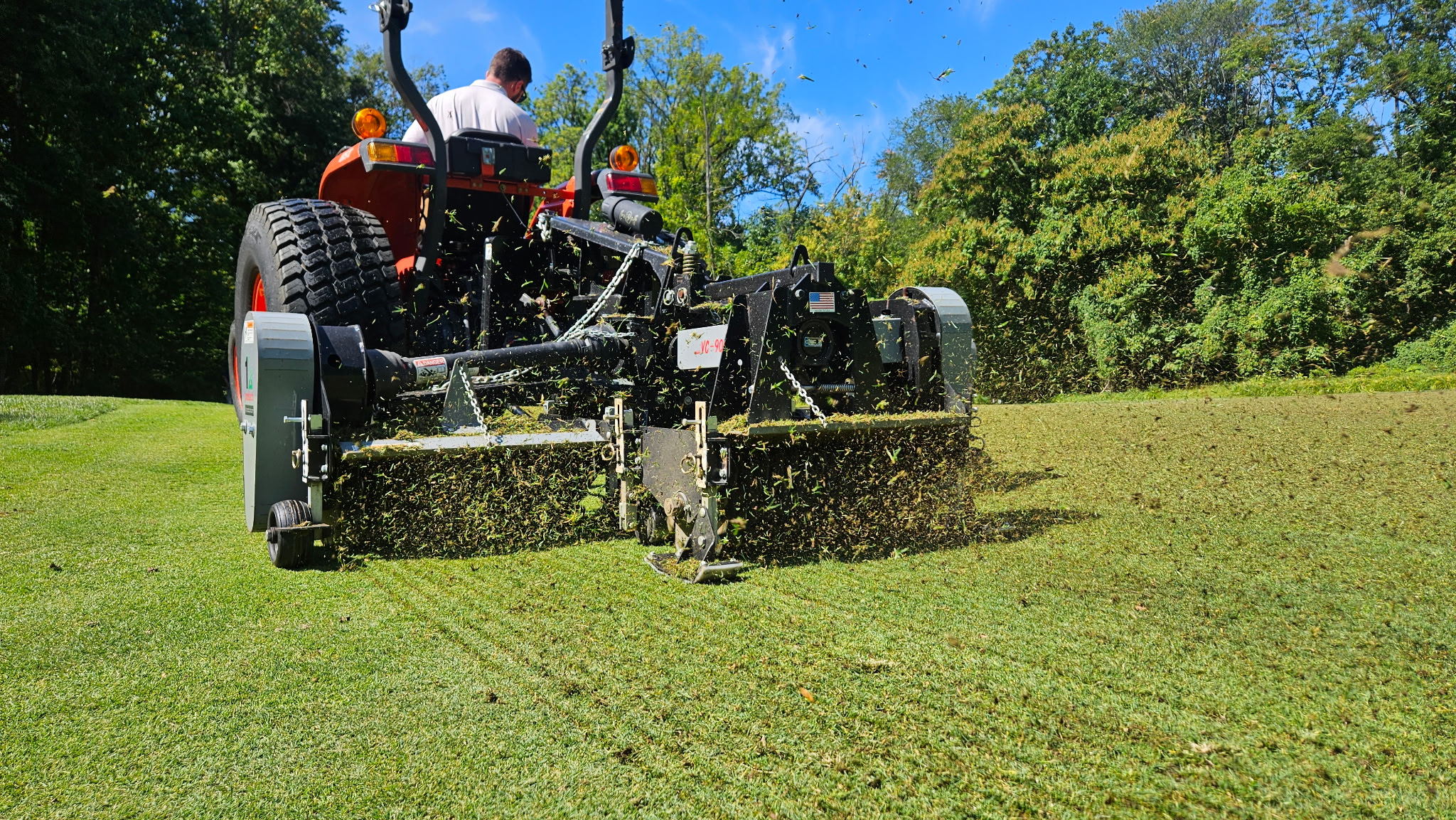
A verticutter uses a shaft fitted with vertically oriented blades that spin at high speed and cut down into the turf profile. As the blades rotate, they slice through the thatch layer, pulling accumulated organic material up to the surface where it can be collected and removed.
The depth and aggressiveness of the cut is adjustable. Light verticutting passes at minimal depth primarily address surface thatch and are used for routine thatch management and surface preparation before overseeding. Deeper, more aggressive passes are used for heavier thatch removal and for stimulating lateral growth in warm-season grasses.
On warm-season grasses like bermudagrass and zoysiagrass, deeper verticutting serves a dual purpose. In addition to thatch removal, the blade action cuts into the stolons and lateral stems of the grass, stimulating new lateral growth that fills in and thickens the stand over time. This is why verticutting is a standard renovation practice on bermudagrass athletic fields and golf fairways, where density and surface uniformity are critical.
The Sports Turf Managers Association (STMA) recommends verticutting as part of a comprehensive thatch management program on athletic fields, particularly in combination with aeration and overseeding for maximum renovation impact.
The 1st Products VERTI-cutter Line
Not all verticutters are built for professional turf applications. Equipment designed for residential or light commercial use often lacks the blade speed, cutting depth range, and structural durability that professional turf managers need across a full season of use.
The 1st Products VERTI-cutter line is engineered for the demands of commercial turf management. The VC-60 features a 54-inch working width and a patented swing-hitch design that allows the unit to turn during operation, which significantly improves maneuverability on large fields without requiring the operator to lift and reposition the machine at every pass end. The belt drive system delivers fast blade RPM through 12-inch diameter blades, which improves cut quality and thatch extraction compared to slower-spinning configurations.
The VC-40 offers a more compact option for operations using smaller tractors or working in tighter spaces. It provides blade spacing options from half an inch to two inches and supports an optional thinner blade for more precise cutting depth control on sensitive turf surfaces.
Both models are built for the duty cycles that commercial turf management actually requires, with all-welded steel construction and component quality designed to hold up through repeated seasonal use rather than just light occasional work.
When to Verticut and How Often
Timing verticutting correctly matters as much as having the right equipment. Verticutting stresses the turf in the short term, so timing the treatment to coincide with periods of active growth gives the turf the best conditions to recover quickly.
For warm-season grasses, late spring through early summer is generally the best window. The grass is actively growing, temperatures support fast recovery, and the full growing season ahead allows the turf to fill back in before winter dormancy.
For cool-season grasses, early fall is the preferred timing. Soil temperatures are still warm enough to support recovery, air temperatures are cooling toward the range where cool-season grasses perform best, and overseeding after verticutting takes advantage of ideal germination conditions.
The frequency depends on how aggressively thatch accumulates on your specific turf. Properties with heavy nitrogen programs, frequent irrigation, and consistent traffic may need verticutting once or twice per season to keep thatch within a manageable range. Lower-input properties may need it less often. The reliable indicator is thatch depth: measure it regularly and schedule verticutting before it exceeds the threshold where it starts affecting surface performance.
Pairing Verticutting with Aeration and Overseeding
Verticutting delivers its best results when it’s part of a coordinated renovation sequence rather than a standalone treatment. The most effective combination for turf renovation is verticutting followed by aeration and then overseeding, in that order.
Verticutting first removes the thatch layer and opens the surface. Aerating after verticutting improves soil conditions for root development. The 1st Products AERA-vator is well-suited for this step, fracturing compacted soil with vibrating tines while leaving the surface in a condition that recovers quickly. Overseeding after both steps puts seed into the most receptive surface conditions possible, with the thatch layer cleared and the soil loosened and open.
This three-step sequence on the right schedule produces results that none of the three practices can achieve independently. Turf that goes through a well-executed renovation sequence consistently outperforms turf that receives the same inputs without the surface and soil preparation that makes those inputs effective.
The Long-Term Case for Consistent Thatch Management
Thatch management is not a one-time fix. It’s an ongoing practice that keeps the turf surface functioning the way it should season after season. Properties that skip verticutting for multiple seasons accumulate thatch to the point where a single treatment can’t address it without significant surface stress and extended recovery time.
Turf managers who build verticutting into a consistent annual or semi-annual program keep thatch at manageable depths, which means each treatment is lighter and recovery is faster. The surface performs better between treatments, inputs are more effective, and the turf builds density over time rather than declining gradually.
That consistency is what separates turf management programs that produce improving results from programs that are constantly trying to recover lost ground. Explore the 1st Products VERTI-cutter and AERA-vator lineup to see how purpose-built turf renovation equipment supports better long-term results, or contact the team to discuss which configuration fits your operation and your seasonal maintenance schedule.