Why Thatch Accumulation Hurts Turf Performance
Thatch is a dense, fibrous layer of dead and living plant material—mainly stems, stolons, and roots—that forms between the soil surface and the green canopy. While a thin layer can help cushion foot traffic and protect against temperature swings, excessive thatch prevents air, water, and nutrients from reaching the root zone. This buildup can suffocate roots, trap pests and pathogens, and reduce the turf’s resilience to stress and disease.
In high-traffic turf systems—whether sports fields, golf fairways, or commercial landscapes—thatch accumulation is one of the leading causes of poor turf quality. It contributes to spongy, uneven surfaces, encourages runoff, and complicates overseeding efforts. As explained in The Ultimate Guide to Aeration, Seeding & Fertilization Equipment, managing the soil-to-surface interface is essential for optimizing plant health, and the verticutter machine is one of the most effective tools for doing so.
What a Verticutter Machine Actually Does
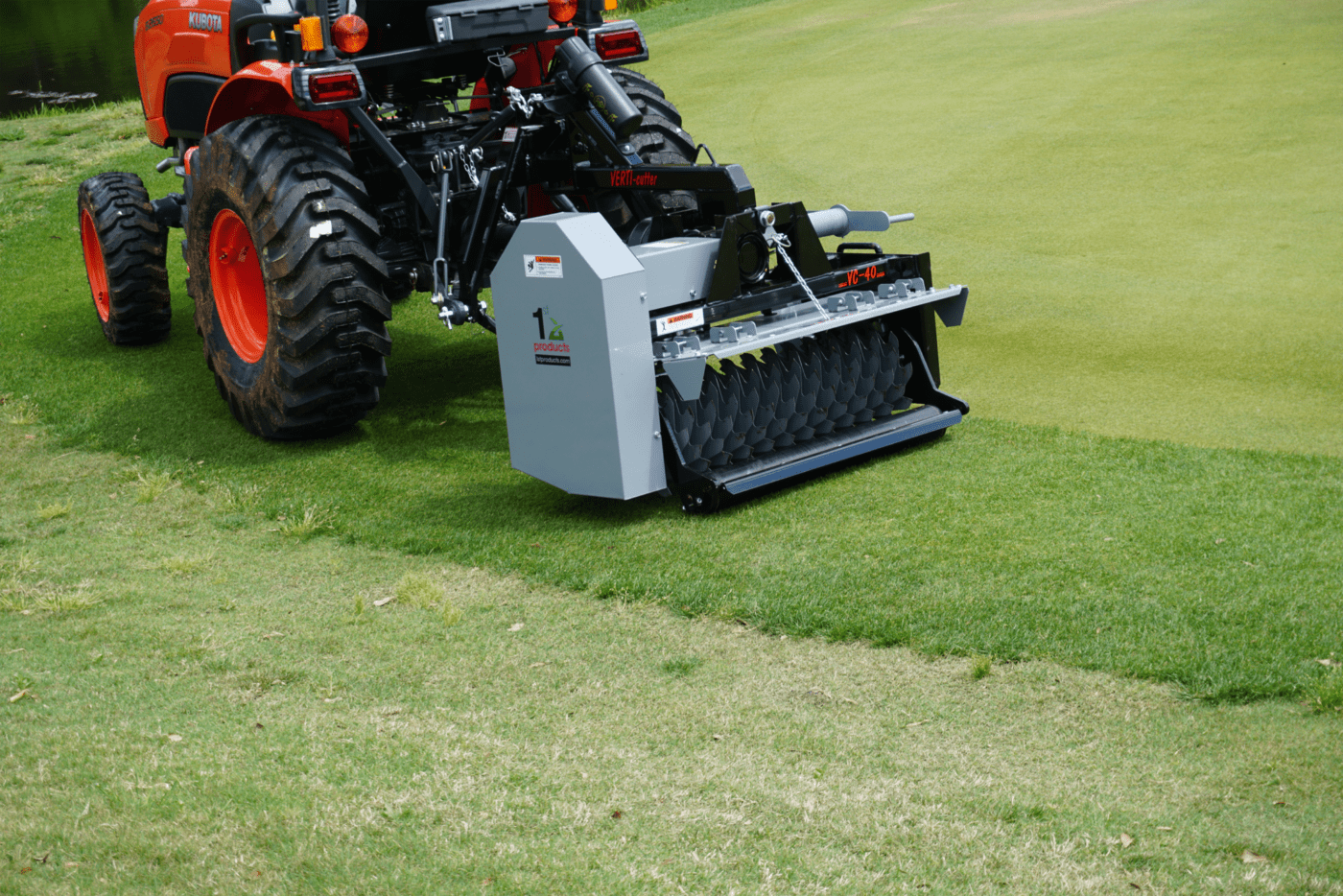
A verticutter machine uses vertical blades to slice through thatch and shallow root zones, removing surface buildup and stimulating new growth. Unlike core aerators that remove plugs of soil, verticutters create narrow slits that promote seed-to-soil contact and open space for air and water infiltration. The action disrupts surface compaction while maintaining turf integrity.
Adjustable blade depth allows operators to adjust verticutting intensity based on turf type, condition, and thatch thickness. On well-maintained grounds, shallow passes can be performed for regular thatch control. On neglected or heavily used turf, deeper slicing may be necessary to restore a breathable soil environment. For professionals managing multiple turf areas, equipment from Turf Wholegoods provides the versatility to adapt across seasons and site conditions.
Verticutting can also enhance the aesthetic appearance of turf by promoting denser lateral growth and reducing patchy or matted areas. This makes it a favorite among sports turf managers, golf course superintendents, and contractors seeking professional, high-performance results.
How Verticutting Supports Soil-Air-Water Exchange
The mechanical action of a verticutter machine does more than reduce thatch—it reopens pathways for oxygen, moisture, and beneficial microbes to reach the root zone. This exchange is crucial for soil biology. A healthy root environment requires oxygen for respiration, moisture for nutrient transport, and microbial activity for decomposition and nutrient cycling.
By breaking up compacted thatch layers, verticutting helps prevent anaerobic conditions that can lead to root rot and disease. It also enables more efficient irrigation. Rather than running off the surface or pooling in thatch, water is directed downward where it can be absorbed and stored by the soil.
These improvements mirror the benefits of mechanical aeration, making the two techniques complementary. To explore how deeper soil loosening supports turf and crop health, How Field Aerators Improve Soil Health & Crop Yields dives into the soil structure side of the equation—highlighting the synergy between subsurface aeration and surface verticutting.
Enhancing Overseeding and Fertilizer Effectiveness
A verticutter machine plays a critical role in optimizing overseeding projects. By creating shallow slits in the turf, it ensures that seed has direct contact with soil—a necessity for germination. Broadcast seeding without verticutting often leads to seed resting on thatch, where it dries out, gets washed away, or fails to root effectively.
Verticutting can also improve fertilizer effectiveness. Nutrients that are applied to a thick thatch layer may never reach the soil. Once sliced open by the verticutter, that surface layer becomes more permeable, and nutrients can be absorbed where they’re needed most. This results in healthier turf and reduces waste due to runoff or volatilization.
How a Grass Seeder Can Save You Time & Money outlines how combining the right seeding tools with turf prep practices like verticutting can result in fewer inputs, faster establishment, and lower long-term costs. Integrating both tools into your workflow ensures each action supports the next, streamlining your operations and maximizing ROI.
Timing and Frequency for Optimal Results
Knowing when to use a verticutter machine is just as important as knowing how. In most regions, spring and early fall are ideal, as temperatures are moderate and soil moisture supports recovery. Cool-season grasses benefit from verticutting in early fall, while warm-season species can be verticut in spring as they begin active growth.
The frequency of verticutting depends on turf species, usage intensity, and local conditions. High-traffic fields and intensively managed turf may need verticutting two to four times per year. In residential or lightly used properties, once per season may suffice. It’s important to monitor thatch depth and turf density to determine the right schedule.
If you’re unsure when or how often to verticut your property, the team at 1st Products can provide personalized guidance based on soil conditions, turf species, and your long-term maintenance goals.
Choosing the Right Verticutter Machine for Your Needs
Not all verticutters are created equal. Choosing the right unit means evaluating blade spacing, depth control, and ease of maintenance. Fixed-blade systems may suit uniform turf, while floating or adjustable heads perform better on uneven terrain. Some units offer interchangeable blade types for customized slicing action depending on thatch density.
For professionals managing large estates, athletic complexes, or multi-use fields, modular designs allow for greater flexibility. The ability to quickly adjust or reconfigure your verticutter reduces downtime and expands the utility of your equipment fleet. Many operators find that pairing verticutting with aeration or seeding in a single pass increases efficiency and results.
To explore verticutting machines that integrate with full-cycle land care, the Agriculture Wholegoods catalog offers dependable, American-made solutions that stand up to years of field use.
Pairing with Equipment for System-Level Turf Care
Verticutting isn’t a standalone solution—it’s part of a larger system of turf health. When used with aerators, overseeders, and fertilizers, it creates an environment where turfgrass can regenerate faster, grow stronger, and resist disease. Planning these treatments as a sequence improves the value of each one.
For example, verticutting ahead of overseeding improves germination, while following up with aeration enhances root development. Depending on your timing and turf type, combining practices might even reduce the total number of treatments required each season.
To learn more about drill-based systems that can work in tandem with verticutting, read No-Till vs. Conventional Drills: Which One Works Best for You?. It details how seeding methods intersect with field conditions—and why mechanical preparation matters for seed establishment success.
What Makes 1st Products a Leader in Turf Innovation
Performance matters, but so does trust in your tools. 1st Products has spent decades developing and refining turf management equipment based on real-world operator feedback. Their verticutter machines reflect that legacy—featuring rugged builds, precise engineering, and patented mechanisms that improve productivity without increasing complexity.
Every unit is built in the U.S. and designed for long-term use across varying terrains and turf species. Whether you manage municipal sports turf, commercial landscapes, or agricultural property, the team at 1st Products offers equipment and support that deliver lasting results season after season.
Durability, adaptability, and field-tested innovation define their products—and ensure your investment continues to perform under pressure.