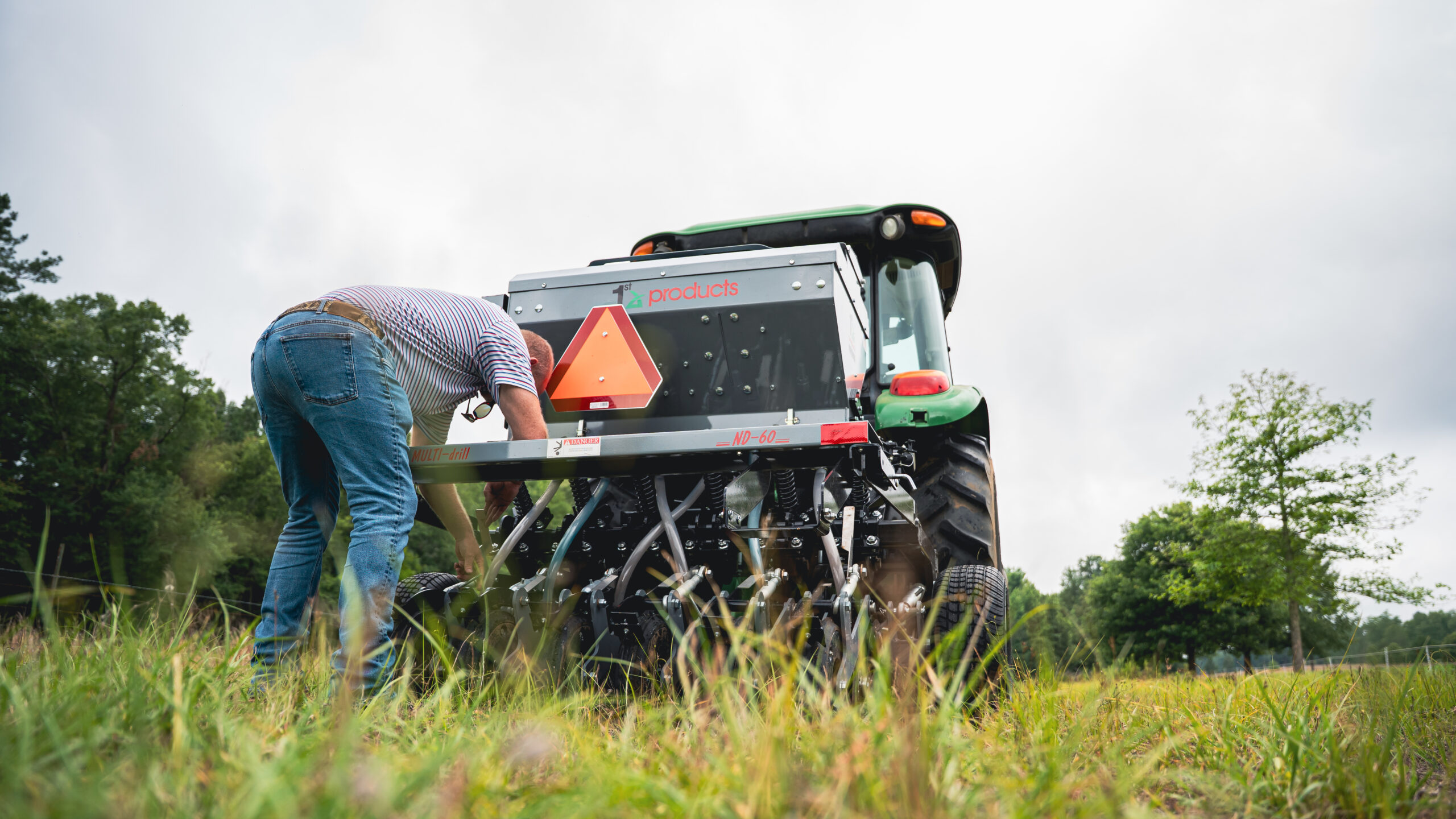
If you’ve spent any time researching seeding equipment for either farming or food plot work, you’ve likely run into both “grain drill” and “food plot drill” in the same conversation. On the surface they look similar. Both are designed to place seed into the ground at a controlled depth. Both use a row-based approach rather than broadcast spreading. And both are a significant step up from simply throwing seed on the ground and hoping for the best.
But the similarities stop there, and understanding where they diverge is important if you want equipment that actually matches what you’re trying to accomplish. Using a grain drill for food plot work, or expecting a food plot drill to handle large-scale commodity production, creates problems that show up in your results even when everything else in your management program is dialed in.
This guide breaks down the real differences between these two tool categories and helps you determine which one belongs in your operation.
What a Grain Drill Is Designed to Do
A grain drill is an agricultural implement built for large-scale commodity crop production. Its core design priorities are throughput, consistency across large acreage, and compatibility with the planting requirements of row crops like wheat, oats, soybeans, and similar grains.
Grain drills are typically wider machines, often spanning 10 feet or more, designed to cover ground efficiently across open fields. They feature multiple seed boxes, ground-driven metering systems, and disc or hoe openers that cut into tilled or prepared seedbeds and deposit seed at a calibrated depth.
For their intended purpose, grain drills perform extremely well. A farmer planting a 200-acre wheat field needs a machine that can maintain consistent row spacing, seeding depth, and seed rate across the entire field without constant adjustment. Grain drills are engineered to deliver exactly that, and they’ve been refined over decades to handle the specific seed sizes and soil conditions that commodity production requires.
The University of Wisconsin Extension and similar agricultural research programs have published extensive data on grain drill calibration and performance for commodity crops, reflecting how central this equipment is to large-scale production agriculture.
What a Food Plot Drill Is Designed to Do
A food plot drill shares the basic concept of mechanical seed placement but is purpose-built for the very different demands of food plot work. Where a grain drill optimizes for scale and throughput on prepared ground, a food plot drill optimizes for versatility, no-till capability, and performance in the variable, often rough terrain that food plotters and wildlife land managers actually work in.
Food plot sites typically don’t look like farm fields. They’re often small clearings, wooded edges, hillsides, or irregular patches of ground that haven’t been tilled. The soil may have roots, rocks, residue, and significant variation in texture and compaction from one end of the plot to the other. A machine designed for flat, prepared agricultural ground struggles in these conditions.
Food plot drills address this with heavier-duty coulters and disc openers that can cut through residue and unprepared ground, narrower overall widths that fit through wooded or irregular terrain, and seed box configurations that handle the wide variety of seed types food plotters use, from clover and brassicas to cereal grains and native grasses.
No-till capability is particularly important. Most food plot locations can’t be tilled without significant site prep work, and in many cases tilling would disturb the ground in ways that create erosion or weed pressure problems. A food plot drill that can seed directly into existing vegetation or light residue without requiring tillage saves time and protects the site.
The 1st Products MULTI-drill is built around exactly these priorities. Available in widths from 5 to 12 feet, the MULTI-drill is designed for no-till seeding in the kind of terrain food plotters and land managers actually encounter. Its construction handles the conditions that would bog down or damage a standard grain drill, and its seed box handles the variety of seed types that food plot mixes require. For hunters and wildlife managers serious about plot success, it’s a different category of tool than a repurposed agricultural drill.
Key Differences That Actually Affect Your Results
Terrain capability. A grain drill assumes relatively flat, prepared ground. A food plot drill is built to handle slopes, residue, and uneven terrain without losing seed placement consistency.
No-till performance. Most grain drills require a tilled or at minimum disk-worked seedbed. A quality food plot drill can cut into undisturbed or minimally disturbed ground, which is often the only realistic option in food plot settings.
Width and maneuverability. Grain drills are wide by design. Getting a 15-foot grain drill into a narrow wooded food plot clearing is often impossible. Food plot drills in the 5 to 8 foot range fit the terrain food plotters actually work in.
Seed variety handling. Grain drills are calibrated for specific seed sizes and shapes. Food plot mixes often combine small seeds like clover with larger seeds like turnips or cereal grains in the same planting. Food plot drills with dual seed box configurations, like the MULTI-drill, handle this mix without requiring separate passes for different seed types.
Scale and cost. Grain drills built for farm-scale production are priced and sized accordingly. For someone managing a few acres of food plots rather than hundreds of acres of commodity crops, the scale mismatch makes a grain drill a poor fit both practically and economically.
Where the Overlap Exists
There are scenarios where a grain drill works fine for food plot-adjacent applications. If you’re planting cereal rye, oats, or wheat as a cover crop or food source on open, relatively flat ground that you can access with a wider machine, a grain drill does the job well. The seed types are familiar to the equipment and the terrain requirements aren’t demanding.
Similarly, some food plot drills can handle light agricultural use if the acreage is modest. The MULTI-drill is capable enough for small-scale cover crop planting and no-till ag applications where a full-size grain drill is overkill.
But when the terrain gets rough, the seed mix gets varied, or the site requires no-till seeding in conditions that a farm drill wasn’t designed for, the gap between these two tool categories becomes very clear in your results.
Choosing Based on Your Actual Use Case
The right question isn’t which tool is better in general. It’s which tool matches what you’re actually doing.
If you’re a farmer planting commodity crops on prepared ground at scale, a grain drill is the right tool and a food plot drill won’t give you the throughput or row spacing consistency you need.
If you’re a hunter, wildlife manager, or land manager planting food plots in variable terrain with mixed seed types and limited site prep, a purpose-built food plot drill is the right tool and a grain drill will fight you every step of the way.
Many operations that involve both commodity production and wildlife management on the same property benefit from having access to both, using each tool where its design advantages actually apply. Explore the 1st Products MULTI-drill to see how it’s built for the specific demands of food plot and no-till seeding work, or contact the team to talk through which width and configuration makes sense for your property and your planting goals.