Commercial grass seeding is one of the most profitable service expansions available to lawn care professionals. Businesses that invest in specialized overseeder equipment unlock higher-margin services while delivering consistent, high-quality results that outperform traditional broadcast seeding.
As the lawn care industry shifts toward precision and efficiency, commercial grass seeding offers a clear path to growth. Service rates typically range from $0.10 to $0.20 per square foot, with average jobs exceeding $1,000, making it a high-value service. Combined with the labor-saving design of modern equipment, these pricing structures create strong profit potential for operators ready to scale.
Understanding Commercial Grass Seeding Equipment
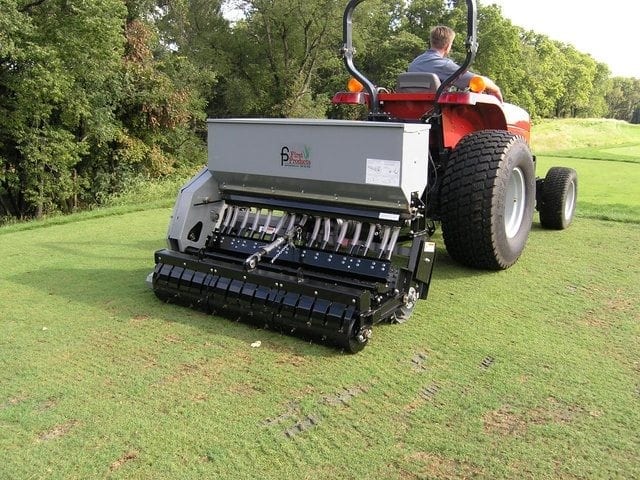
Commercial grass seeding relies on purpose-built equipment that ensures seeds make direct soil contact for optimal germination. Unlike traditional broadcast methods—where seeds often rest on the surface and fail to take root—professional lawn seeders and overseeders place seed precisely into the soil, leading to faster establishment and thicker, healthier turf.
These machines come in a range of configurations to meet different job requirements. Walk-behind models offer maneuverability for residential spaces, while tractor-mounted units are built for larger commercial or municipal properties. This flexibility allows lawn care providers to select the right tool for each application, from reseeding bare patches to revitalizing full-acre landscapes.
Professional overseeding systems feature components like adjustable blade depth, calibrated seed metering, and heavy-duty construction for daily commercial use. Tools like the MULTI-drill and the AERA-vator from 1st Products are engineered for modular performance, meaning operators can configure them for seeding, soil prep, or renovation work—maximizing ROI and equipment utilization across seasons.
Revenue Advantages of Professional Seeding Services
Commercial grass seeding offers lawn care businesses a profitable way to expand services and attract new clients. Many property owners begin looking for lawn care when dealing with bare spots, patchy turf, or renovation needs—making seeding services a natural entry point. It also provides opportunities to upsell overseeding to existing clients who want to improve turf density or introduce new grass varieties for improved resilience.
Industry-wide, landscape service margins typically range from 5% to 20% per job. However, professional grass seeding can command higher margins due to the technical nature of the work and the specialized equipment required. With the right setup, operators can complete jobs faster, with better results, while justifying premium pricing.
The efficiency of modern overseeding equipment has a direct impact on profitability. Tools like the AERA-vator enable operators to prep and seed in a single pass—eliminating the need for multiple steps and reducing labor hours. This streamlined process increases daily job capacity and minimizes material waste, boosting both productivity and net revenue. To explore how drill attachments improve operational efficiency, read more about tractor seeding systems.
Superior Results Drive Customer Retention
Professional overseeder equipment consistently delivers better results than traditional broadcast methods. By placing seed directly into the soil with controlled depth and spacing, overseeding systems dramatically increase germination rates—producing thicker, more uniform turf that satisfies even the most demanding clients.
This precision placement eliminates many of the challenges associated with surface seeding, such as poor soil contact and uneven growth. The visible difference in turf health not only justifies premium pricing but also builds trust—leading to stronger customer retention and word-of-mouth referrals.
In many cases, seeding services serve as the gateway to ongoing client relationships. While overseeding is typically performed once per year, successful projects often lead to follow-up services like fertilization, aeration, and seasonal maintenance. When seeding is positioned as part of a full-service care plan, it opens the door to recurring revenue and long-term client loyalty. For a deeper look at how equipment supports these services, explore the aeration and seeding equipment guide.
Equipment Investment and ROI Considerations
Investing in professional overseeder equipment is a long-term strategy for increasing both productivity and profitability. While the upfront cost may be higher than traditional methods, the return comes through faster job completion, better seed utilization, and reduced maintenance over time.
High-performance systems allow contractors to take on larger-scale projects that would be inefficient or unfeasible with smaller or rental-grade tools. Some tractor-powered aeration systems, for example, are capable of covering up to 3 acres per hour—helping crews complete more jobs per day without sacrificing quality.
1st Products’ modular solutions, like the AERA-vator, offer even greater ROI by supporting multiple turf care functions. Operators can easily configure a single piece of equipment for seeding, aerating, or renovating—maximizing equipment usage across seasons and service types without the need for separate machines.
Operational Efficiency and Time Savings
Today’s commercial grass seeding equipment dramatically reduces the time and labor required to complete turf renovation projects. Older methods—such as pairing core aeration with a broadcast seeder—often required multiple passes and still resulted in uneven germination, especially in compact soils.
Modern overseeders eliminate this inefficiency. Equipment like 1st Products’ multi-tine seeding systems can prepare the soil and plant seed in a single pass, embedding seed directly into the surface for more consistent coverage. This streamlined process improves seed-to-soil contact, eliminates waste, and minimizes the need for repeat applications.
Fewer passes mean faster job completion and reduced wear on crews and equipment. By increasing daily job capacity and improving seed utilization, lawn care operators can serve more customers during peak seasons while maintaining competitive pricing and high service standards.
Market Positioning and Competitive Advantages
Commercial overseeding, also known as slice or slit seeding, remains a highly specialized service—one that not all lawn care providers are equipped to offer. This specialization presents a clear competitive advantage for operators who invest in professional equipment and master the technical skills required for consistent results.
Unlike basic lawn care tools, professional grass seeders are precision machines that require proper calibration, experience, and training to use effectively. Their cost and complexity serve as a natural barrier to entry, making it difficult for less-equipped competitors to match the quality or efficiency of service. This expertise not only supports premium pricing but also builds long-term client trust.
The visual transformation of a seeded lawn speaks for itself. Whether you’re managing golf courses, high-end residential properties, or commercial campuses, visibly healthier turf can increase property value and enhance client satisfaction. These tangible results fuel word-of-mouth referrals and open doors to additional service opportunities.
Looking to expand your offering with professional overseeding capabilities? Contact our team or find a local dealer to explore your equipment options.
Seasonal Revenue Optimization
Commercial grass seeding presents a reliable way to optimize revenue throughout the growing season—particularly during early fall, when soil and air temperatures are ideal for germination. With sufficient moisture, sunlight, and fertilization, new seedlings can establish strong roots before winter, setting the stage for long-term turf health.
Seeding services align well with the natural rhythms of lawn care. While tasks like mowing or leaf removal may taper off, overseeding offers a profitable bridge that extends the service calendar into slower months. This consistency helps contractors maintain cash flow and improve year-round equipment utilization.
Modern overseeding equipment also allows for greater flexibility. Precision controls enable operators to work effectively in a range of soil conditions, expanding the window for successful application beyond traditional methods. By maximizing each season’s potential, lawn care providers can generate stronger returns on both equipment and labor investments.
Long-term Business Growth Strategies
Investing in commercial grass seeding equipment supports long-term business growth by enabling service diversification and increasing production capacity. Professional overseeders allow operators to target new markets—such as commercial campuses, athletic fields, and large residential estates—where results and consistency are non-negotiable.
Scalable equipment platforms, like the AERA-vator, offer modular configurations that adapt to different property sizes and job scopes. This flexibility reduces the need for multiple single-use machines while ensuring high performance across varied conditions.
Standardized, repeatable results across crews and locations help contractors maintain brand quality as they grow. This consistency supports premium pricing, boosts customer retention, and provides a strong foundation for expanding services into new regions or verticals over time.
Frequently Asked Questions
What makes commercial grass seeding more profitable than traditional broadcast seeding?
Commercial grass seeding equipment offers higher germination rates, greater accuracy, and reduced material waste compared to traditional broadcast methods. By placing seed directly into the soil, these machines ensure better turf establishment while cutting down on rework. The efficiency gained—fewer labor hours, fewer passes, and consistent results—translates into increased daily job capacity and the ability to charge premium rates.
How quickly can lawn care businesses see ROI from overseeder equipment investment?
Return on investment depends on factors like service pricing, job volume, and equipment utilization. However, many businesses begin recouping costs within the first season by offering overseeding as a high-margin service. Adding seeding to a broader portfolio—such as aeration or fertilization—can also accelerate ROI through bundled service offerings and recurring customer contracts.
What types of properties benefit most from professional grass seeding services?
Properties that demand high-quality turf establishment or repair—such as sports fields, municipal grounds, commercial landscapes, and large residential lawns—see the greatest benefits. These areas often face challenges like compaction, heavy foot traffic, or uneven growth, all of which are ideal use cases for precision seeding equipment that delivers consistent results across varied terrain.
Ready to grow your lawn care business with precision seeding?
Explore 1st Products’ professional overseeders and modular turf equipment designed to boost productivity and profitability. View equipment lineup.
{ "@context": "https://schema.org", "@type": "FAQPage", "mainEntity": [ { "@type": "Question", "name": "What makes commercial grass seeding more profitable than traditional broadcast seeding?", "acceptedAnswer": { "@type": "Answer", "text": "Commercial grass seeding equipment ensures better seed-to-soil contact, resulting in higher germination rates and thicker turf. Compared to broadcast seeding, it reduces material waste, labor hours, and the need for repeat applications—leading to increased job capacity and premium pricing opportunities." } }, { "@type": "Question", "name": "How quickly can lawn care businesses see ROI from overseeder equipment investment?", "acceptedAnswer": { "@type": "Answer", "text": "Many lawn care businesses begin seeing a return on investment within their first season, especially when overseeding is bundled with other services like aeration or fertilization. The equipment increases efficiency, enabling more jobs per day and higher-margin services that boost overall profitability." } }, { "@type": "Question", "name": "What types of properties benefit most from professional grass seeding services?", "acceptedAnswer": { "@type": "Answer", "text": "Properties such as athletic fields, commercial campuses, municipal grounds, and large residential lawns benefit greatly from professional grass seeding. These areas often require durable, uniform turf and face conditions like soil compaction or patchy growth—making precision seeding essential for long-lasting results." } } ] }